How Much Laptop RAM & Storage Do You Really Need? (2025 Guide)
When buying a new laptop, one of the trickiest decisions is figuring out how much RAM and storage you need. Should you go with 8GB or 16GB of memory? Is 512GB of SSD storage enough? These specs can make or break your experience, especially if you plan to multitask or store large files.
While this guide focuses on laptops, the same advice applies to most modern desktop PCs as well, particularly when it comes to choosing the right amount of RAM or SSD space for everyday tasks.
Affiliate Disclosure
This post contains affiliate links. If you click a link and make a purchase, we may earn a small commission at no extra cost to you. As an Amazon Associate, we earn from qualifying purchases.
Table of Contents
- Understanding Laptop RAM
- Understanding Laptop Storage
- How Much RAM & Storage Do You Need in 2025?
- Can You Upgrade RAM or Storage Later?
- Top Picks Based on RAM & Storage Needs
- Frequently Asked Questions
- Final Verdict: Pick the Specs That Fit Your Workflow
1. Understanding Laptop RAM
RAM (Random Access Memory) is where your laptop temporarily stores data it’s actively using. The more RAM you have, the more apps and browser tabs you can keep open at once without slowing your system down.
Why RAM Matters
RAM plays a huge role in multitasking and overall responsiveness. It doesn’t store files permanently like a hard drive, but it gives your device short-term memory essential for fast performance when switching between tasks, loading large spreadsheets, or editing photos.
Common RAM Sizes in 2025
| RAM Amount | Best For |
|---|---|
| 8GB | Basic web browsing, video streaming, email, light Office use |
| 16GB | Ideal for students, professionals, and light creative work |
| 32GB+ | Great for video editing, development, CAD, or heavy multitasking |
How Much RAM Do You Actually Need?
- Students & Everyday Users:
8GB may be enough for light tasks like note-taking, web browsing, and streaming, but in 2025 it’s already starting to feel tight. 16GB is a much smarter long-term choice, especially if you multitask with multiple apps or browser tabs. - Developers & Professionals:
Aim for 16GB at minimum. If you use tools like Visual Studio, run virtual machines, or work with large datasets, 32GB is often a better fit. - Creatives (Photo/Video Editing):
For 4K video editing, high-resolution design work, or complex Photoshop files, 32GB or more will give you the performance and responsiveness you need. - Gamers:
Most modern games run smoothly on 16GB, but some newer titles and background apps perform better with 32GB, especially if you’re streaming, modding, or multitasking while playing.
Important: In 2025, 8GB is the absolute minimum, and even then it can feel limiting, especially for users who keep lots of browser tabs or background apps open. If you plan to keep your laptop for 3–5 years, or want to avoid upgrading early, 16GB should be your starting point.
Many thin laptops solder the RAM directly to the motherboard, which means it can’t be upgraded later. Be sure to choose a configuration that not only meets your needs today, but gives you room to grow.
2. Understanding Laptop Storage
Storage is where your laptop saves everything permanently, from your operating system and apps to photos, documents, and games. Choosing the right type and amount of storage affects both performance and how much space you’ll have down the line.
Types of Laptop Storage
SSD vs HDD
- SSD (Solid State Drive): Much faster, more reliable, and standard in nearly all modern laptops.
- HDD (Hard Disk Drive): Cheaper and larger, but slower. Rare in 2025 outside of budget models or external backups.
If you’re buying a new laptop, get an SSD; the speed difference is night and day.
SATA vs NVMe SSDs
- SATA SSD: Faster than HDDs, but slower than newer SSD types. Still fine for most basic users.
- NVMe SSD: Modern standard with lightning-fast speeds ideal for boot times, app launching, and large file transfers.
Common Storage Sizes in 2025
| Storage Size | Best For |
|---|---|
| 256GB | Casual users, light files, cloud storage users |
| 512GB | Balanced choice for most users with apps, media, and school/work files |
| 1TB+ | Creatives, professionals, and anyone who stores videos, games, or large local files |
How Much Storage Do You Need?
- Students / Web Users: 256GB can be enough if you store most files in the cloud and don’t install many apps. But even then, space can get tight. 512GB offers better breathing room and more long-term flexibility.
- Professionals & Remote Workers: 512GB to 1TB is ideal if you regularly install software, work with large documents, or need to manage multiple projects locally.
- Gamers & Creators: 1TB or more is best for storing large games, raw video footage, design files, and creative software libraries.
- Power Users: If your workflow involves huge files, multiple operating systems, or offline backups, consider supplementing your internal drive with an external SSD or cloud storage plan.
Important: The advertised storage size is not the full amount you’ll be able to use. After accounting for the operating system and preinstalled software, a 256GB SSD may only give you around 200GB of usable space out of the box.
And that space fills up quickly. System updates, cached files, downloads, and media libraries all add up faster than you expect. If your budget allows, stepping up to 512GB or 1TB now can save you from headaches down the road, especially if storage isn’t easily upgradeable later.
3. How Much RAM & Storage Do You Need in 2025?
Still unsure what’s right for you? Here’s a quick overview of ideal configurations based on how you use your laptop:
| User Type | Recommended RAM | Recommended Storage |
|---|---|---|
| Students & Casual Users | 8GB (16GB preferred) | 256GB–512GB SSD |
| Remote Workers & Professionals | 16GB | 512GB–1TB SSD |
| Gamers | 16GB–32GB | 1TB SSD or more |
| Developers | 16GB–32GB | 512GB–1TB SSD |
| Photo/Video Creators | 32GB+ | 1TB+ SSD |
These specs aren’t just about performance today; they help future-proof your laptop so you won’t need to upgrade too soon.
4. Can You Upgrade RAM or Storage Later?
Many people assume they can upgrade later, but it’s not always that simple with modern laptops.
Soldered vs Upgradable RAM
- Soldered RAM is permanently attached to the motherboard, a common practice in ultrabooks, MacBooks, and many thin laptops.
- Upgradable RAM allows you to add or swap out memory, but it is increasingly rare in consumer models.
Tip: Always check the specs before you buy. If long-term flexibility matters, look for models that explicitly mention upgradeable RAM.
Storage Is Often Easier to Upgrade
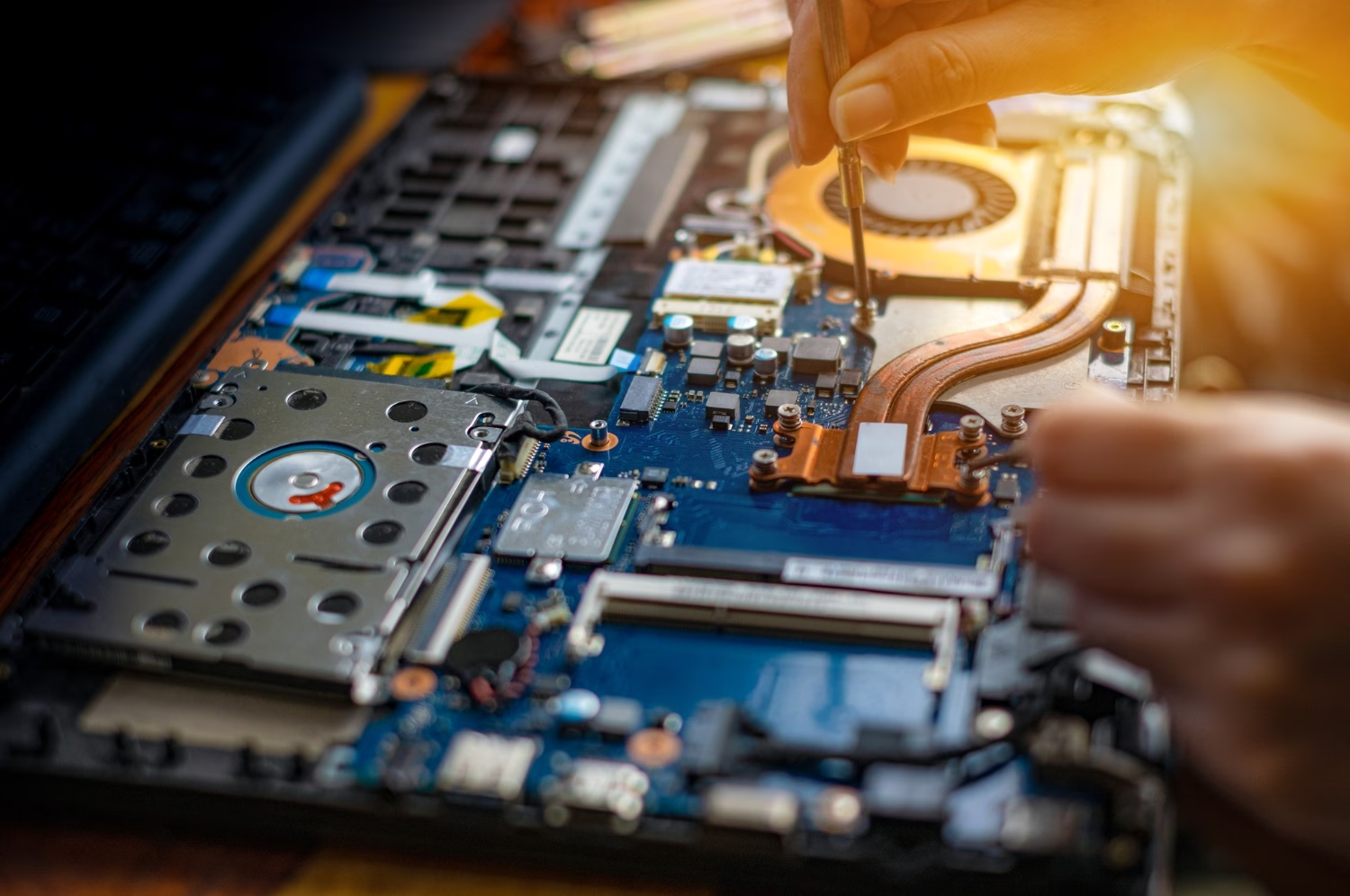
- Most Windows laptops use M.2 NVMe SSDs, which are user-replaceable in many models, making storage upgrades relatively simple if you’re comfortable opening the device.
- MacBooks, however, do not allow internal storage upgrades. What you buy is what you’re stuck with, so be sure to carefully consider your current and future needs before purchasing.
- Even if internal upgrades aren’t an option, external SSDs are fast, affordable, and easy to use. If you’re okay carrying a portable drive, it’s a great way to expand your storage without breaking your budget, especially for photos, video, and project files you don’t need access to 24/7.
When Upgrading Makes Sense
If your laptop feels slow but isn’t too old, a few key upgrades can extend its useful life if the hardware supports it. Some laptops let you add more RAM or replace the internal SSD with a larger or faster one, which can significantly improve everyday performance.
However, keep in mind that many modern laptops have soldered RAM or non-upgradeable storage, especially thinner ultrabooks and MacBooks. Always check your laptop’s specifications before buying upgrade parts.
Still not sure if it’s worth the investment? Check out our guide: Should You Repair or Replace Your Laptop?
5. Top Picks Based on RAM & Storage Needs
Here are our top laptop recommendations tailored to different user needs from casual computing to high-performance gaming.
Shopping by Specs?
These picks are grouped by RAM and storage tiers to help you find the best value based on your performance needs, whether you’re upgrading from an older machine or buying your first laptop.
Entry-Level Pick
Lenovo IdeaPad Slim 3 (2025) – 15.6″ Display, AMD Ryzen 3, 8GB RAM, 256GB SSD
If you’re on a tight budget and only need a laptop for web browsing, email, or schoolwork, this entry-level device can get the job done. That said, in 2025, 8GB of RAM is starting to show its limits, and most users will benefit from stepping up to 16GB for smoother performance and longer device life.

- SMART MULTITASKING: Work smart and seamlessly on multiple tasks with the latest AMD Ryzen 3 7320U processor and 8GB of memory. Featuring a slim, lightweight and military-grade resilient design.
- AMPLE STORAGE: With 256GB of storage there is no shortage for your projects, family photos and memories.
- SEE MORE, LEARN MORE: Learn more about the world with the FHD IPS display, while keeping your eyes safe with TÜV-certified Low Blue Light.
- LEARN SMARTER: Smarter learning starts with smart features from Lenovo AI Engine to enhance power, display, voice and wireless connections.
- CRYSTAL CLEAR AUDIO: Integrated Dolby Audio with two built in 2W speakers and a dual microphone make the audio clearer than ever.
Better Budget Option
Acer Aspire 5 – 15.6″ Display, Intel Core i7, 16GB RAM, 512GB SSD
This affordable upgrade gives you more memory and storage for better multitasking and long-term value. With 16GB of RAM and a fast SSD, the Aspire 5 is a smart choice for students and home users who want a smoother experience without breaking the bank.

- Do What You Do With Exceptional Performance: The 13th Gen Intel Core i7-1355U processor goes beyond performance to let your PC do even more at once. And Intel Iris Xe graphics distribute performance where you need it most.
- Clear and Comfortable Viewing: Experience crisp, lifelike colors, and sharp details on the 15.6” FHD IPS display. You have more space to work thanks to narrow bezels.
- The Design: The slim 0.70″ body and aluminum top cover give the Aspire 5 a premium feel and appearance. An ergonomic hinge design lifts the body of Aspire 5 and tilts the backlit keyboard for comfortable typing, improved cooling, and a better sound experience.
- Smooth Operator: Experience engineered solutions to maximize cooling supporting multiple cooling modes and dual copper thermal pipes. Expel more heat with the air inlet keyboard to keep your cool when it counts.
- Internal Specifications: 16GB LPDDR5 memory; 512GB PCIe Gen4 SSD to store your files and media; Windows 11 Home
Shopping by Use Case?
Not sure what specs are right for your lifestyle or work? These picks are organized by real-world scenarios so you can find the laptop that fits your everyday life.
Best for Students
Dell Inspiron 5441 – 14″ Display, Snapdragon X Plus, 16GB RAM, 512GB SSD
Portable, efficient, and Copilot+ ready, the Dell Inspiron 5441 is a smart choice for students who want all-day battery life, smooth multitasking, and a stylish, lightweight design. It’s ideal for schoolwork, video calls, research, and organizing your digital life, all without breaking the bank.

- Built For Fast-Paced Lifestyles: On-device AI powered by Snapdragon X Plus gives you responsive performance and power efficiency.
- Ultimate Mobility: Thin and light laptop with exceptional battery life so you can stream, create and plan on the go.
- Captivating Visuals: Get true-to-life color and sound with FHD+ resolution and 300 nits brightness levels.
- Qualcomm Oryon CPU: The Snapdragon X Plus 10 core give you boosted performance and efficiency so you can quickly create, collaborate, share and tackle complex workloads like a pro.
- Qualcomm Adreno GPU: Renders stunning, high-quality graphics output without a hitch.
Best for Gamers
Acer Nitro 16 (2025) – 16″ Display, AMD Ryzen 7, RTX 4060, 16GB RAM, 1TB SSD
Built for gaming and multitasking, the Nitro 16 delivers a great balance of power and price with smooth frame rates, fast load times, and serious storage for your entire game library.

- Revolutionizing Performance: The AMD Ryzen 7 8845HS processor is crafted to provide outstanding premium experiences. Immerse yourself in high-speed performance while streaming and gaming, relishing reliable functionality, intelligent battery management, and groundbreaking technologies that bring the AI experience closer to you.
- AI-Driven Graphics: Experience lifelike visuals and unparalleled performance with the cutting-edge NVIDIA GeForce RTX 4060 laptop graphics. The integration of DLSS 3.5 technology takes your gaming to new heights, enhancing beauty, immersion, and realism. This innovative AI-powered technique elevates the quality of ray tracing, providing an even more captivating gaming experience.
- Picture-Perfect. Furiously Fast: Engage thoroughly with a captivating 16-inch 165Hz display that comes to life featuring a 16:10 WUXGA 1920 x 1200 resolution. The brilliance of vibrant sRGB 100% ensures that each color maintains its pristine quality. The Mux Switch offers a visual spectacle where each frame remains flawless, and every movement is free from tearing.
- Internal Specifications: 16GB DDR5 Memory (2 DDR5 Slots Total, Maximum 32GB); 1TB PCIe Gen 4 SSD (2 x PCIe M.2 Slots) | Ports For All Your Accessories: 1 – USB Type-C Port- – supporting USB4 (up to 40 Gbps), DisplayPort over USB Type-C, and USB Charging, 2 – USB 3.2 Gen 2 Ports (One Featuring Power-off Charging), 1 – HDMI 2.1 Port with HDCP support, 1 – Headphone/Speaker/Line-out Jack, 1 – Ethernet (RJ-45), DC-in for AC adapter, 1 – Kensington Lock Slot
- Copilot in Windows: Introducing Copilot in Windows (in preview) a new AI-powered intelligent assistant designed to provide answers and inspirations from the web, foster creativity and collaboration, and assist in maintaining focus on your tasks. Activating Copilot is easy; simply use the dedicated Copilot key on the keyboard.
Best for Creators
MacBook Air M4 (2025) – 13.6″ Display, Apple M4, 16GB RAM, 256GB SSD
Apple’s M4 chip delivers excellent performance for content creators. With a brilliantly color-accurate display, all-day battery life, and silent fanless operation, it’s perfect for photo editing, video work, music production, and design on the go.

- SPEED OF LIGHTNESS — MacBook Air with the M4 chip lets you blaze through work and play. With Apple Intelligence,* up to 18 hours of battery life,* and an incredibly portable design, you can take on anything, anywhere.
- SUPERCHARGED BY M4 — The Apple M4 chip brings even more speed and fluidity to everything you do, like working between multiple apps, editing videos, or playing graphically demanding games.
- BUILT FOR APPLE INTELLIGENCE — Apple Intelligence is the personal intelligence system that helps you write, express yourself, and get things done effortlessly. With groundbreaking privacy protections, it gives you peace of mind that no one else can access your data — not even Apple.*
- UP TO 18 HOURS OF BATTERY LIFE — MacBook Air delivers the same incredible performance whether it’s running on battery or plugged in.*
- A BRILLIANT DISPLAY — The 13.6-inch Liquid Retina display supports 1 billion colors.* Photos and videos pop with rich contrast and sharp detail, and text appears supercrisp.
Best for Remote Professionals
ASUS ExpertBook P5 Copilot+ – 14″ Display, Intel Core Ultra 7, 32GB RAM, 1TB SSD
Designed for serious multitaskers, this business-ready laptop combines next-gen AI features with premium specs. Whether you’re managing meetings, editing documents, or running dev tools, this machine keeps pace.

- ASUS ExpertBook/GREY/14.0 WQXGA(WQ) non-Touch/CORE ULTRA 7 258V/32GB/Intel UMA/1TB/WIN11 HOME
- AI-Powered performance for multitasking — Intel Core Ultra 7 Processor 258V with Intel AI Boost NPU offering up to 47 TOPS for AI task processing, and Intel Arc 140V Graphics for smooth visuals.
- Microsoft Copilot in Windows — Help is here with Copilot in Windows, your everyday AI companion. Get answers, generate images, summarize texts, and more.
- Fast and seamless — Lightning-fast 1 TB SSD storage, 32 GB of 8448 MHz LPDDR5X RAM, and Wi-Fi 6E, ensuring seamless connectivity and operation.
- Thin-and-light design for portability — Slim profile at just 0.65 inches thin and a lightweight all-metal 2.84 lb chassis.
Best for Everyday Use
ASUS Zenbook 14 OLED – 14″ Display, AMD Ryzen 7, 16GB RAM, 512GB SSD
A beautiful, balanced ultrabook for casual users who want fast performance, premium build quality, and an OLED display all in a sleek form factor.

- [High Speed Memory & Storage & OS] Seal is opened and resealed for upgrade only. Upgraded to 16GB DDR5 SDRAM; 512GB PCI-E NVMe SSD; Windows 11 Home
- [AMD Ryzen 7 8840HS Processor] Latest powerful and efficient AMD Ryzen 7 8840HS Processor (Up to 5.1 GHz, 24 MB AMD 3D V-Cache, 8 Cores, 16 Threads)
- [14″ OLED WUXGA Touchscreen] 1920 x 1200 pixels, multi touch-enabled, 500 nits, 16:10 aspect ratio, 100% DCI-P3, Thin Bezel LCD; Powered by [AMD Radeon Graphics]
- [Connection & Ports] Wi-Fi 6E (2×2) 802.11AX and Bluetooth 5 Combo; 1x USB 4.0 Type-C support Power Delivery / DisplayPort, 1x USB 3.2 Gen 2 Type-C support Power Delivery / DisplayPort / 10Gbps, 1x USB 3.2 Gen 1 Type-A support 10Gbps, 1x HDMI v2.1, 1x Headphone and microphone combo jack
- [Features] Backlit Keyboard; 1080p FHD Camera with Privacy Shutter; 75Whr 4-Cell lithium-ion battery (up to 8 hours battery life); 12.30″ x 8.67″ x 0.59″ inches, 2.82 lbs; Jade Black; 65W AC Adapter; Free COU 32GB USB Drive included
Frequently Asked Questions
It depends on your needs. For basic tasks like email, web browsing, and word processing, 8GB is still usable, but it’s no longer ideal. In 2025, most users will benefit from 16GB for smoother multitasking and better long-term performance.
You only need 32GB if you’re doing heavy creative work, running virtual machines, compiling code, or gaming while streaming. For everyday productivity, 16GB is usually the sweet spot.
Always choose an SSD. It’s significantly faster, more reliable, and uses less power than a traditional hard drive. Even a small SSD will feel snappier than a large HDD.
Some laptops allow RAM upgrades, but many thin-and-light models have soldered memory that can’t be changed. Always check the specs before buying; if it’s non-upgradeable, go for 16GB or more upfront.
If most of your files live in the cloud (like Google Drive, iCloud, or OneDrive), 256GB might be enough. But if you install a lot of programs or keep files locally, 512GB is a safer bet.
If you multitask or run demanding apps, prioritize more RAM. If you store large files or install lots of software, prioritize more storage. Ideally, aiming for both 16GB RAM and 512GB SSD is a great starting point.
Final Verdict: Pick the Specs That Fit Your Workflow
When it comes to laptop RAM and storage, there’s no one-size-fits-all answer; it depends entirely on how you use your computer.
- For very casual tasks like browsing, streaming, and schoolwork, 8GB RAM and a 256GB SSD will get the job done.
- For productivity, creative work, or future-proofing, 16GB+ RAM and 512GB+ SSD is the sweet spot.
- Gamers, developers, and media pros should aim for 32GB RAM and 1TB+ SSD to avoid bottlenecks.
Your laptop’s performance will only be as good as the hardware inside it, and choosing the right specs now can save you from slowdowns, upgrades, or regrets down the line.
Ready to Buy a Laptop That Fits Your Needs?
Now that you know how much RAM and storage you need, it’s time to shop smart. Whether you’re a student, gamer, creative, or remote worker, choosing the right specs today means fewer slowdowns and headaches tomorrow.
Scroll back to check out our top laptop picks, each one matched to specific use cases so you don’t overspend or underbuy.
Need more help? Check out our other laptop buying guides or reach out for personalized advice.
Want even more reading? Check out our Tablet vs Laptop Comparison or Best Laptops for Working from Home.